GEA
GEopolymer based Adsorbents for effective adsorption and selective separation of CO2 and eutrophication pollutants
Principal investigator: Valentina Medri
Starting date: 16/10/2023
Duration: 24 month
Total Funding: 203.604,00 €
Action: PIANO NAZIONALE DI RIPRESA E RESILIENZA (PNRR) Missione 4 “Istruzione e Ricerca” – Componente C2 Investimento 1.1, “Fondo per il Programma Nazionale di Ricerca e Progetti di Rilevante Interesse Nazionale (PRIN)” PRIN 2022 – D.D. 104 del 02/02/2022
CNR-ISSMC role: Coordinator
Coordinator: Valentina Medri (CNR-ISSMC)
Consortium: Consiglio Nazionale delle Ricerche (CNR-ISSMC); DICAM – Università di Bologna
GEA project deals with the development of synthetic alkali aluminosilicates, namely geopolymers, for separation and purification applications, exploiting adsorption mechanisms for the capture of CO2 or nitrogen or phosphorous-based pollutants in wastewater. The goal includes the identification of when and why a geopolymer-based material can be preferred to a benchmark adsorbent.
It is noteworthy that geopolymers are environmentally friendly (and low cost) materials:
- they are produced at max 80°C with a water-based synthesis from naturally abundant materials such as clays using a green chemistry approach;
- some reagents may be obtained from wastes, still guaranteeing a controlled purity and stoichiometry;
- it is possible to reuse geopolymers after exhaustion in other applications (e.g. in new building materials), that is a crucial advantage over the benchmark adsorbents such as activated carbon.
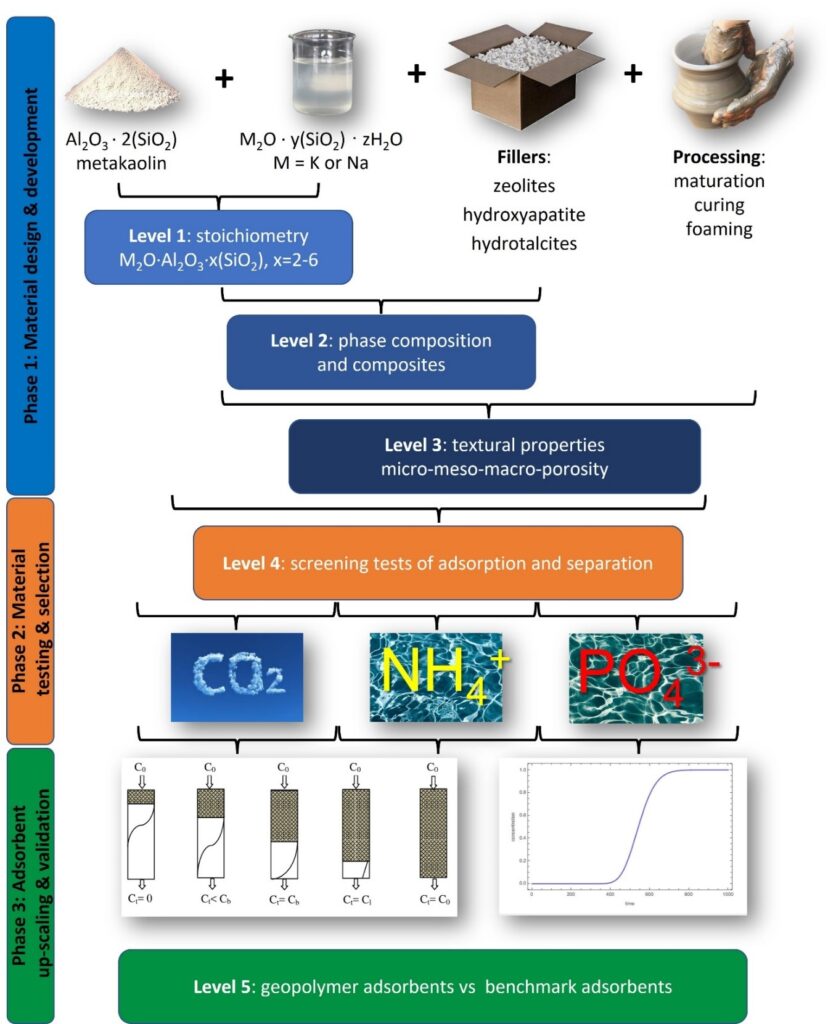
GEA will develop a geopolymers platform with the ambition to link adsorption/desorption ability and selectivity versus ionic species and gases to compositional and morphological variables such as: stoichiometry, phase composition (also in composites) and textural properties (directly linked to micro-macrostructure). Acting on the variables, porosity, pore size/distribution and chemistry will be conveniently tuned for the targeted adsorption applications of the project, that are:
1) carbon dioxide adsorption and separation from CO2 concentrated sources (e.g. flue gases), in the context of a Carbon Capture and Storage (CCS) strategy;
2) removal of ammonium and phosphates from wastewater with the aim of eutrophication prevention and critical raw materials recovery (recovery and separation of phosphorus).
The results of GEA will disclose the possibility to customize eco-friendly materials (low energy production process) for specific adsorption purposes and to identify geopolymer matrices able to actively increase in composites the performances of other adsorbent such as zeolites, apatites, hydrotalcites. Furthermore, the project results will finally clarify the real potentiality of geopolymers-based adsorbents in comparison to benchmark adsorbents at the large scale.
It follows that impacts of GEA in the field of adsorption are expected to be:
- Scientifically sound and relevant, as the project will overcome the main bottlenecks currently hindering a wider use of geopolymer adsorbents, enhancing the reproducibility of the results also related to raw materials and processing, and the gap between research studies, often using unrealistic scenarios (e.g. synthetic wastewaters), and real ones which are much more complex.
- Technologically relevant since the use of geopolymers allows to easily customize the shape of the solid adsorbent to the separation plant and increase long-term mechanical performances and duration.
- Economically relevant because geopolymer synthesis can be performed with a fairly low energy input.
In GEA, previous knowledge will be exploited to generate the platform of a new family of eco-friendly and less expensive solid adsorbents, developing different levels of systematic understanding and modelling of the effect of the main geopolymer variables on adsorption performances. The GEA project will be articulated in 3 Phases (Fig. 1), briefly described below. Phase 1 related to Material Design & Development and Phase 2 related to Material Testing & Selection will be conducted iteratively.
Final results:
Four adsorbents were selected—including a stoichiometric geopolymer and composites incorporating zeolite or hydrotalcite—produced using various techniques (slurry route, cold sintering process, direct foaming) in the form of granules, foam, or pellets. These results were achieved through the development of the materials platform that constitutes the primary objective of the GEA project. Furthermore, processes were optimized for each adsorbent regarding CO2 separation from flue gases, as well as the separation and recovery of phosphates and ammonium from wastewater. The performance of the selected materials was compared with that of benchmark adsorbents to highlight their potential, also taking into account environmental impact (LCA) and cost analysis.
CO2 adsorption:
1) CSP GX90-P10-N4 cold sintered geopolymer composite with 90 wt.% of zeolite Na13X
2) F-KG2-Z1 geopolymer composite foam containing 22 wt.% of zeolite Na13X
NH4+ and PO43- adsorption:
3) G13/KG2, stoichiometric potassium based geopolymer with SiO2/Al2O3=4 and K2O/Al2O3=1
4) KG2-S911-10%, geopolymer composite with G13/KG2 as geopolymer matrix and 10 wt.% of hydrotalcite Sorbacid911.
The results regarding materials and/or processes development have already been discussed in:
- Medri, M. C. Marchioni, E. Landi, E. Papa, Development of membranes based on recycled geopolymer and zeolite through a cold sintering process, Journal of the European Ceramic Society, 44 (2024) 7778-7790. https://doi.org/10.1016/j.jeurceramsoc.2024.05.053. CC-BY.
- Maggetti, D. Pinelli, V. Di Federico, L. Sisti, T. Tabanelli, F. Cavani, D. Frascari, Development and validation of an adsorption process for phosphate removal and recovery from municipal wastewater based on hydrotalcite-related materials, Science of The Total Environment, 951 (2024) 175509. https://doi.org/10.1016/j.scitotenv.2024.175509. CC-BY-NC-ND.
- Papa, V. Medri, E. Landi, Geopolymer-hydroxyapatite composite foams for wastewater remediation, Ceramics International, 50 (2024) 50377-50387. https://doi.org/10.1016/j.ceramint.2024.09.383. CC-BY.
- Maggetti, D. Pinelli, E. Girometti, E. Papa, V. Medri, E. Landi, F. Avolio, D. Frascari, Development of an ion exchange process for ammonium removal and recovery from municipal wastewater using a metakaolin K-based geopolymer, Chemosphere, 367 (2024) 143559. https://doi.org/10.1016/j.chemosphere.2024.143559. CC-BY.
- Di Pietro, W. F. Cossio Guzman, E. Papa, E. Landi, F. Miccio, M. Minelli, V. Medri, Cold sintered geopolymer and geopolymer-zeolite composite sorbents for CO2 capture, Journal of Environmental Chemical Engineering, 13 (2025) 117098. https://doi.org/10.1016/j.jece.2025.117098. CC-BY.
- Temellini, C. Maggetti, D. Pinelli, E. Girometti, V. Di Federico, M. Venturi, E. Papa, V. Medri, Frank Benstoem, Dario Frascari, Development of a combined filtration and ion exchange process for the treatment of combined sewer overflow, Journal of Environmental Chemical Engineering, 13 (2025) 118443. https://doi.org/10.1016/j.jece.2025.118443. CC-BY-NC-ND.
- Maggetti, D. Frascari, D. Pinelli, V. Di Federico, V. Medri, E. Papa, E. Landi, T. Tabanelli, F. Cavani (2024). Nitrogen and Phosphorus Removal and Recovery from Municipal Wastewater by Means of Adsorption and Ion Exchange. In: Mannina, G., Cosenza, A., Mineo, A. (eds) Resource Recovery from Wastewater Treatment. ICWRR 2024. Lecture Notes in Civil Engineering, vol 524. Springer, Cham. https://doi.org/10.1007/978-3-031-63353-9_12. (Conference article).
- Cossio Guzman W.F., Di Pietro C., Minelli M., Medri V., Frascari D., Pinelli D., Papa E., Landi E., Miccio F., 2025, Geopolymer-based Adsorbents for Pollutant Removal: a Tunable Platform Ranging from CO2 Capture to Nitrogen/phosphorus Removal and Recovery from Wastewater, Chemical Engineering Transactions, 117, 919-924. https://doi.org/10.3303/CET25117154. (Conference article) (CET provides immediate open access).
- Pinelli, B. Martellotti, E. Girometti, L. Bernacchioni, G. Antonioni, V. Cozzani, D. Frascari, Multicomponent anion exchange simulation of phosphate removal and recovery from municipal wastewater using Aspen Adsorption, Journal of Water Process Engineering, 88 (2026) 110163, https://doi.org/10.1016/j.jwpe.2026.11016. CC-BY.
One more publication was already submitted:
- Cossio Guzman; C. Di Pietro; E. Papa; V. Signorini; D. Frascari; E. Landi; V. Medri; F. Miccio, M. Minelli, CO2 adsorption in structured Na13X zeolite-geopolymer composites: Performance comparison under dynamic flow of cold-sintered pellets vs. foamed monoliths, Materials Today Sustainability (2026)
At least two other papers will be finalized and submitted, regarding:
- Development of an ion exchange process for simultaneous removal and recovery of ammonium and phosphate recovery from municipal wastewater.
- Comparative Life Cycle Assessment of Geopolymer Composites for CO2 Capture and Wastewater Nutrient Removal.
Dissemination
The most important action of dissemination is related to the achievement of milestone 5 of the GEA project, namely the workshop entitled “Geopolymer for Environmental Remediation”, held in Faenza on February 14th, 2025. The program along with the abstracts of oral and poster contributions, and presentations are available in open access on the workshop webpage https://www.issmc.cnr.it/en/workshop-gea/
Acknowledgments: the research activities of GEA project were funded by the European Union – Next Generation EU.

